
- News
- faces2001
The Many Faces of Psychological Research in the 21st Century
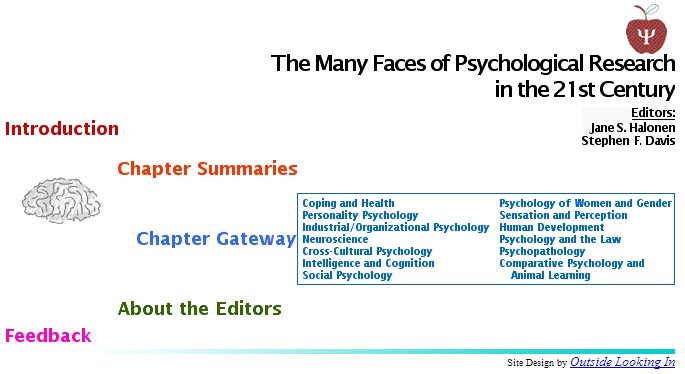
Edited by Jane S. Halonen & Stephen F. Davis
James Madison University, Emporia State University
Published by the Society for the Teaching of Psychology (December 14, 2001)
ISBN: 978-1-941804-00-1
Download the Word (docx) Version (1.5 Mb, includes interactive Flash objects in the Sensation & Perception chapter if you have Adobe Flash installed)

Background
In early 2001, the Society for the Teaching of Psychology (STP) was approached by Jane Halonen and Steve Davis and agreed to an innovative proposal. STP would become the publisher of a new text, The Many Faces of Psychological Research in the 21st Century, as edited by these well-known educators and the book would be offered exclusively in an online electronic format as an "e-book." Comprised of thirteen chapters written by seventeen leading scholars and teachers, Many Faces provides a broad overview of what research agenda and approaches this new century calls for across many of psychology's subdisciplines. STP hopes that this text can serve psychology instructors and students in many diverse teaching contexts.
Suggested Reference Format
Halonen, J. S., & Davis, S. F. (Eds.). (2001). The Many Faces of Psychological Research in the 21st Century. Retrieved from the Society for the Teaching of Psychology Web site: http://teachpsych.org/ebooks/faces/index_faces.php
Individual chapters may be referenced in this fashion:
Matsumoto, D. (2001). Cross-cultural psychology in the 21st century. In J. S. Halonen & S. F. Davis (Eds.). The many faces of psychological research in the 21st century (chap. 5). Retrieved from http://teachpsych.org/ebooks/faces/index_faces.php
Feedback regarding Many Faces
Feedback regarding the editorial content of this book or any of its chapters should be directed toward the individual authors or the book's editors, Jane Halonen and Steve Davis. They (authors and editors) are solely responsible for the substance of the text.
Feedback regarding technical matters of formatting or accessibility of this text via the online environment of the Internet should be directed to the Internet Editor of STP. If you have any complaints or difficulties in accessing these materials, be sure to provide as detailed a description of your problem(s) as you can; you should include information about the browser you are using and its version number as well as the type of computer you are using and its operating system. Publication of The Many Faces of Psychological Research in the 21st Century electronically is an experimental initiative by STP and we seek to receive feedback, both positive and negative, in order to evaluate the effort. We will endeavor to respond to any complaints within a reasonable period of time but can not promise that all complaints or difficulties can always be successfully resolved.
Acknowledgment and Thanks
Both the editors and STP would like to express our appreciation to Brian Halonen who was responsible tackling many of the editorial and technical formatting challenges of this book. Thanks, Brian!
Copyright Policy
Copyright in this web site generally is owned by APA Division 2, Society for the Teaching of Psychology. However, copyright in individual articles and similar items are generally owned by the author(s), except as otherwise noted. You may review the materials in this site for information purposes and may download and print ONE copy of the materials for your own personal use, including use in your classes and/or sharing with individual colleagues. No other permission is granted to you to print, copy, reproduce, or distribute additional copies of these materials. Anyone who wishes to print, copy, reproduce or distribute additional copies must obtain the permission of the copyright owner. Particular care to obtain the copyright owners' permission should be taken by anyone who intends to use this book or its chapters in any commercial enterprise or "for profit" educational purposes.
We note specifically that copyright for the individual chapters found in the book, The Many Faces of Psychological Research in the 21st Century, is owned by the author(s) of that chapter rather than by APA Division 2, Society for the Teaching of Psychology. Distribution of the copyrighted materials of Many Faces at this web site is by a non-exclusive license to STP granted by their respective owners. Under provisions of this license, these materials will be available at this site at least until December, 2005.